
Antoine Bourges, Concrete Valley, 2022


The En Línea section of Concreta’s website is structured around three spaces: Relatorías, Conservatorios, and Pantallas, the latter dedicated to the presentation of audiovisual works accompanied by critical essays.
In 2026, curator Andrea Franco has conceived for Pantallas a programme of four films that will unfold throughout the year.
The selection of these films was guided very intuitively by the premise that each one would be released with the arrival of a new season. Some are steeped in luminosity, others in a crepuscular atmosphere. In each narrative, something belongs more properly to spring (such as gathering flowering plants), to summer (a time of year conducive to periods of idleness), to autumn (through the idea of a change of cycle, of transformation), and to winter (a time of retreat, deep reflection, and solitude).
At the same time, and in keeping with Concreta’s project, these titles engage with some of the social, political, and cultural questions that have appeared in the journal in recent years: reflections on identity and belonging to a place; exile and migration; the problems of communication through language; tensions between groups of different backgrounds; and the spaces of respite that are created when a community takes shape. Always poised between fiction and documentary, they inhabit the natural hybridity that defines much of contemporary cinema, where the image stands as a faithful reflection of an uncertain and changing time.
The film selected for this new instalment of the programme is Concrete Valley (2022), by Canadian filmmaker Antoine Bourges. Through a subtle and restrained narrative, the film explores the difficulties of building a new life far from one’s place of origin, as well as the family tensions, communication problems and transformations of identity that accompany the experience of migration. The text that follows, entitled ‘Learning to Be Someone Else’, accompanies this new instalment of the programme.
Title: Concrete Valley
Author: Antoine Bourges
Year: 2022
Duration: 90 minutes
Credits: Courtesy of the artist
*The video will be available to watch from 30 October to 30 November.
Learning to Be Someone Else
By Andrea Franco
Perhaps Concrete Valley is a film about distances. The distance that gradually grows between a couple; the distance between the place where they are and the place they come from; the distance between naturalness and pretence, between ease and awkwardness. Some of these distances are visible, while others can only be sensed. Concrete Valley is about building a life in a new place while one’s personal life falls apart. It is about learning a language in order to communicate with the outside world, while silence is preferred at home.
Antoine Bourges’s second film, following the brilliant Fail to Appear (2017), constructs a plot that is as subtle in its narrative architecture as it is complex in its representation of the nuances that shape social and family relationships.
Farah and Rashid emigrated from Syria to Canada with their son Ammar. For the past five years they have lived in Thorncliffe Park, a Toronto neighbourhood built in the 1950s beside a forest, in the spirit of old urban utopias, as a complex of high-rise buildings intended to house large families. Over time, it has become a kind of port of arrival for new immigrants, and the surrounding area is home to English-language schools and organisations that facilitate integration. Farah works in a drugstore; although she misses her former life as an actress, she finds new motivation in an environmental awareness group. Rashid, however, has been unable to regain the position he held in Syria as a practitioner of natural medicine. Without work or a licence to practise, he spends his days prescribing remedies to his neighbours, although the response is not always what he hopes for.
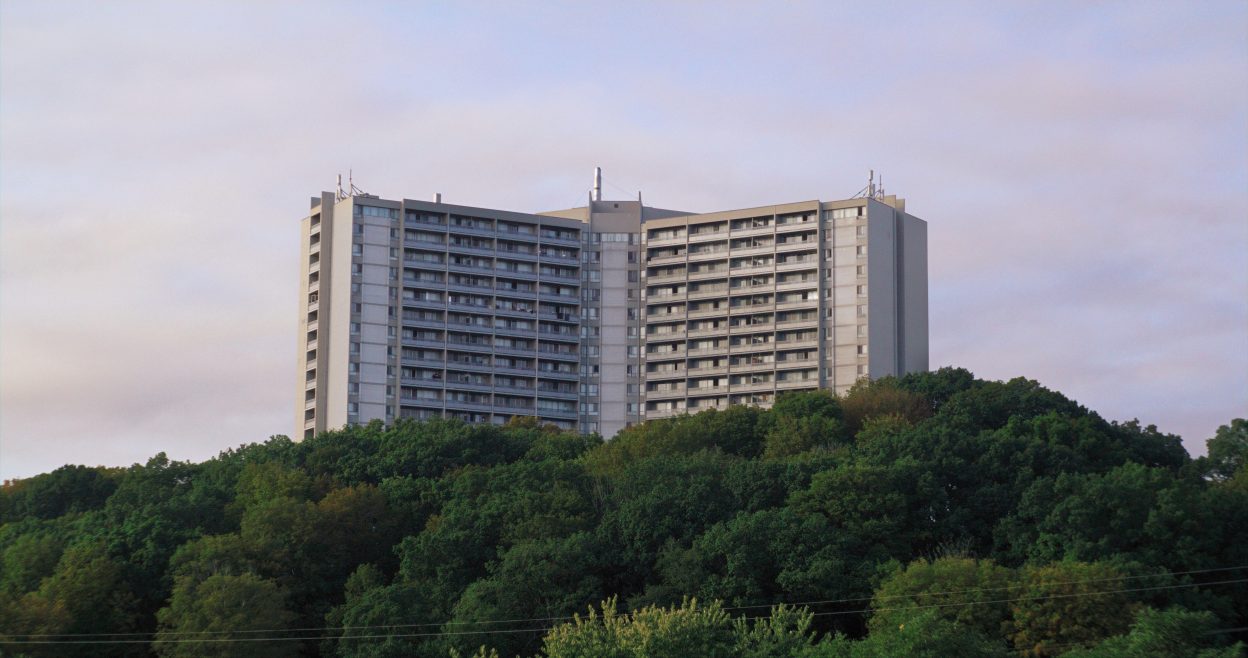
Bourges makes full use of the possibilities offered by this unusual neighbourhood to orchestrate a web of human relationships mediated by limited communication, in which assumptions and misunderstandings abound. While the great masses of concrete loom from every corner like an enormous obstacle on the horizon, the forest functions as an indeterminate place, a kind of no-man’s-land in which the protagonist likes to lose himself from time to time, blurring an identity in crisis. We never see the characters beyond the boundaries of this concrete valley, except perhaps travelling by car, but never inhabiting other parts of a city that does not belong to them, never moving through an urban space of which, as foreigners, they are not yet a part.
Without major dramatic or verbal conflicts, the film gradually takes shape through the small details of everyday life that slowly erode the foundations of its structures. As the screenplay explores how Farah and Rashid confront their new circumstances, and how their former identities must change in order to fit into a new environment, the mise-en-scène translates the differences between them into the frame, working from the very first sequence around an emptiness interrupted only by the occasional presence of their child and his various bids for attention amid silences and crossfire.

Antoine Bourges’s cinema, always interested in characters in states of vulnerability whom he portrays with empathy, flaws and weaknesses included, radiates an optimism that is unusual in contemporary cinema. Rashid, somewhat intrusive, overly critical and at times even arrogant, is also a generous man who wants to be useful to his community, and when he invents a story that turns him into a minor neighbourhood hero, we cannot help but sympathise with his very human need for acceptance.
There is no need to mention war or poverty to sense that all the characters who inhabit Concrete Valley have difficult histories behind them. Bourges is not interested in social denunciation, but rather in leaving the drama off-screen in order to focus on how people must make their way through it: how to sustain a life when everything that once defined it has been left behind.