
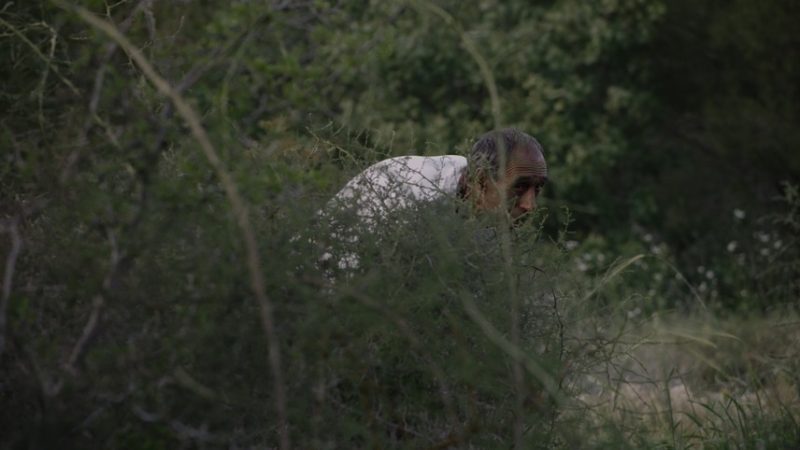
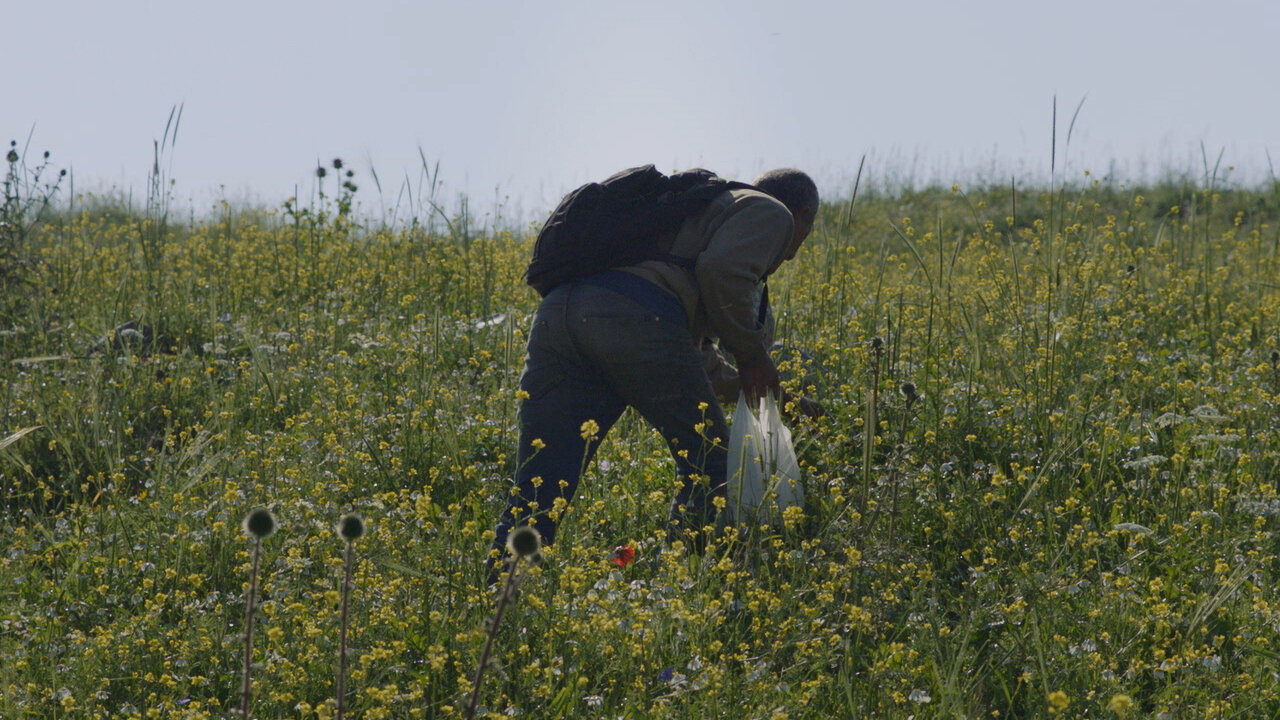
Jumana Manna, Foragers, 2022


The Online section of Concreta’s website is structured around three spaces: Relatorías, Conservatorios, and Pantallas, the latter dedicated to the presentation of audiovisual works accompanied by critical essays. In 2026, curator Andrea Franco has conceived for Pantallas a programme of four films that will unfold throughout the year.
The selection of these films was guided very intuitively by the premise that each one would be released with the arrival of a new season. Some are steeped in luminosity, others in a crepuscular atmosphere. In each narrative, something belongs more properly to spring (such as gathering flowering plants), to summer (a time of year conducive to periods of idleness), to autumn (through the idea of a change of cycle, of transformation), and to winter (a time of retreat, deep reflection, and solitude).
At the same time, and in keeping with Concreta’s project, these titles engage with some of the social, political, and cultural questions that have appeared in the journal in recent years: reflections on identity and belonging to a place; exile and migration; the problems of communication through language; tensions between groups of different backgrounds; and the spaces of respite that are created when a community takes shape. Always poised between fiction and documentary, they inhabit the natural hybridity that defines much of contemporary cinema, where the image stands as a faithful reflection of an uncertain and changing time.
The first in Andrea’s curated selection is Foragers (2022), by Palestinian artist and filmmaker Jumana Manna, a film that, moving between documentary and fiction, examines the political and cultural tensions surrounding the gathering of wild plants in Palestine. The text that follows, written by Andrea Franco, accompanies this first instalment of the programme.
Title: Foragers
Author: Jumana Manna
Year: 2022
Lenght: 65 minutos
Credit: Film and stills courtesy of the artist
*The video will be available to watch from 18 March to 19 April.
A Drone Among the Flowers
By Andrea Franco
From a bird’s‑eye view, a drone closely observes the movements of a man gathering wild plants in the Golan Heights. A melody of unhuman, metallic sounds accompanies the shot—a propeller cutting through the wind, distant bells, a rhythmic flute, like a respirator. Image and sound immediately evoke one of the familiar visions of war: the pointer of a military drone spotting a human target.
Without yet imagining, in the year it was made, the terrible turn of events in Palestine and the West Bank, Foragers places us in one of the many scenes of tension in which Arabs and Jews have been living for almost eighty years in the face of the expansion of settler colonies and under the laws of the Israeli army. In a mountainous region teeming with certain wild plants, another kind of battle is being waged.
Akkoub (a thistle with medicinal properties) and za’atar (a mixture of thyme, sumac, hyssop, and marjoram, essential in the cuisine of countries such as Lebanon, Syria, Turkey, and Palestine) grow abundantly in the valleys and hills where Palestinian communities have harvested these plants for generations for personal consumption.
In the seventies, Israel designated za’atar a protected species, and since 2011 it has prohibited Arabs from harvesting za’atar and akkoub under penalty of fines and punishment, forcing them to buy those grown in the kibbutzim.
With an evocative hybridization of fiction and documentary, alternating small scenes from everyday life with slightly dramatized situations, Jumana Manna reveals the beauty and resilience of this traditional practice and its criminalization in the courts.
The film follows several gatherers (including the director’s own parents) and captures their free, light movements at ground level. In a mysterious sequence, the camera seems to become the conscience of nature, like a spirit wandering among the plants or running along the bark of trees; and as such, as a conscience, it is quickly crushed by the sound of machinery leveling the ground in the distance.
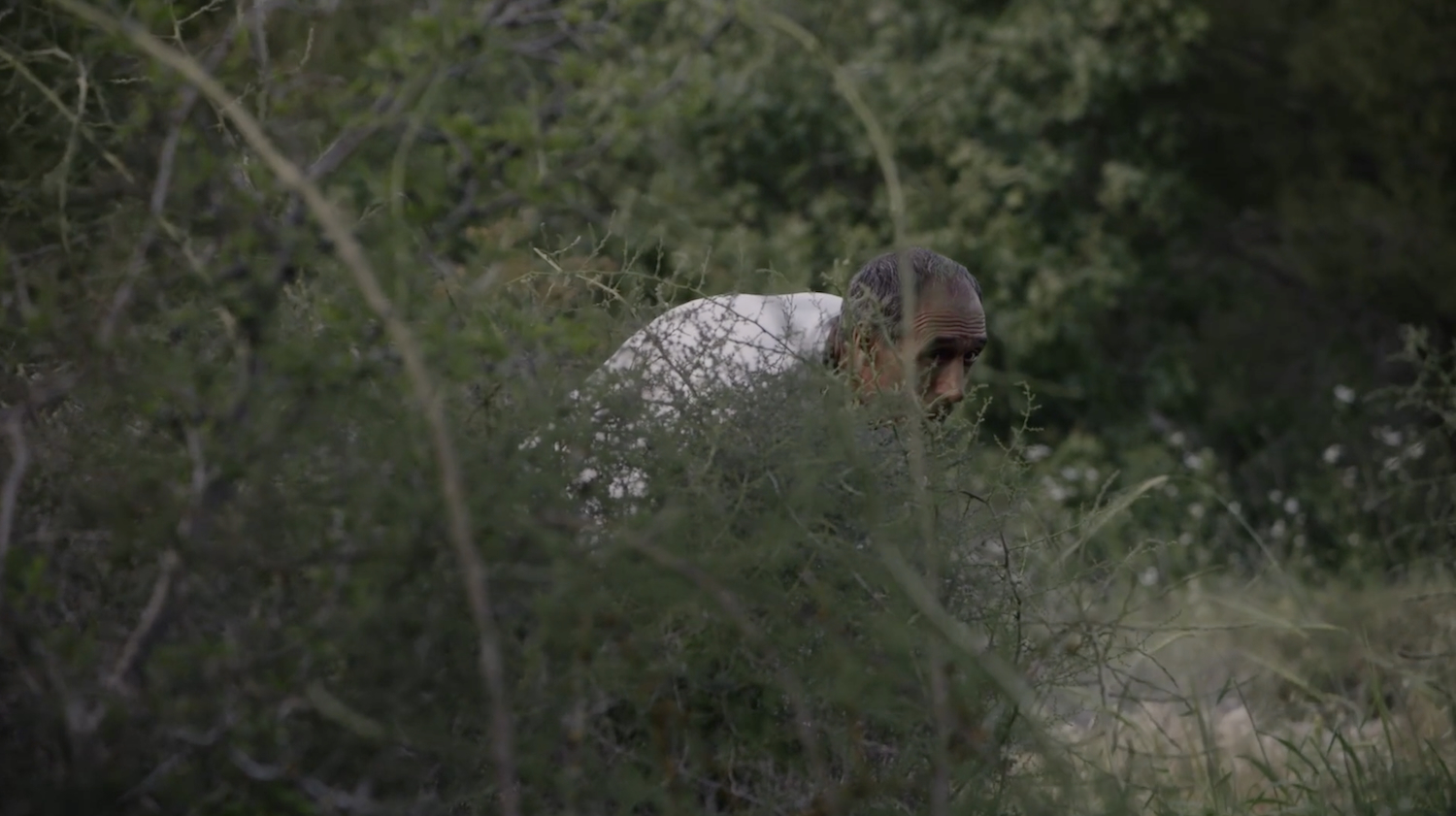
In contrast to these mobile and fragile shots, the court hearings that Palestinians must attend when they are caught foraging are filmed in rigid, fixed frames. These scenes, based on real situations and co‑written with law scholar Rabea Eghbariah, reveal the harassment and intimidation exercised by Israeli authorities in the occupied territories. Prohibiting the gathering of wild plants is just one of the many forms of occupation, and Israel’s intervention in a territory it claims to control reproduces practices typical of the long history of colonialism and slavery—social domination and cultural appropriation.
Very occasionally, someone like Samir refuses to pay the fines or stop collecting, but only in the realm of fiction. Through her artistic practice, Manna allows her neighbors to confront this real and frequent fear and even challenge it, turning the set into a place of liberation and subversion.
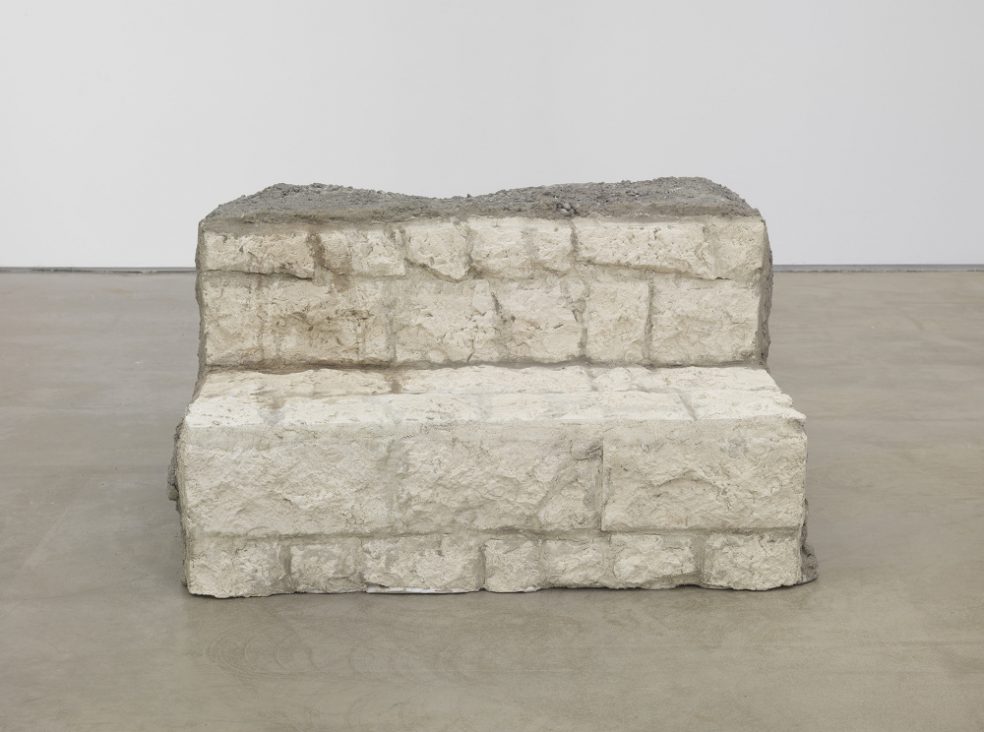
Jumana Manna’s artistic work has developed with remarkable consistency from her first sculptures to her films. It is easy to see in an early installation such as Menace of Origins (2014) the forms, objects, and ideas that take shape in shots from Foragers: archaeology, ruins, dispossession. As a visual artist, she has conceptualized the different forms of violence perpetrated against Palestine and other colonized societies, while as a filmmaker she has focused on questioning the real meaning behind the different forms of preservation devised by power structures: the preservation of folk music in A Magical Substance Flows into Me (2016); the preservation of seeds in gene banks in Wild Relatives (2018); the preservation of protected species in Foragers. Behind each of these decisions lies a perverse hegemony.
In the film, a new drone view now flies over the remains of Akbara, a village whose inhabitants were expelled in 1948. “My parents lived here,” “That was the courtyard where we played,” say two women walking among the ruins. Only Zeidan Hajib lives here now with his dogs, among these traces of the Nakba.
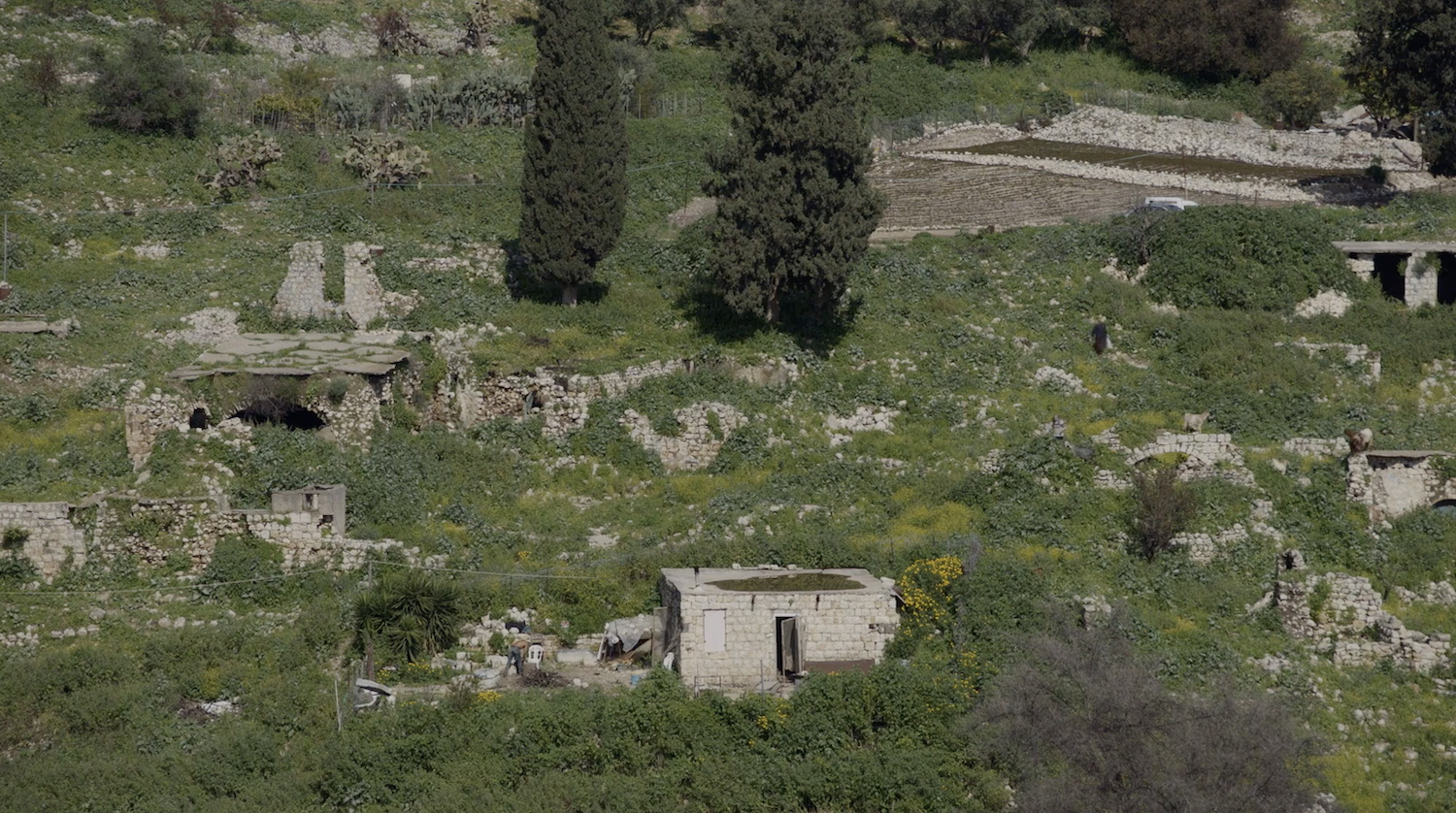
The director has mentioned the writings of Ann Laura Stoler and her concept of ruination[1]. “In contrast to the romantic view of ruins, ruination refers to their active state, both as a force of destruction and as something that suffers perpetual violence.”[2] However, despite everything, it is also “something from which life can spring,”[3] and searching for food among the ruins is its most eloquent result.
Lush greenery continues to envelop everything[4]. Akkoub and za’atar, whose seeds are scattered by the wind, are metaphors for Palestinian resistance; they will never die. Nature belongs to no one—if anything, to all the non‑human species that inhabit it with lustful devotion, without walls or barbed wire. At night, when the patrols sleep, they are the absolute masters of the fields.
Notes:
[1] STOLER, ANN LAURA: Imperial Debris: On Ruins and Ruination, Duke University Press, Durham, 2013.
[2] An evening with Jumana Manna, Columbia University & Center for Palestine Studies.
[3] Íbidem.
[4] Regarding the unusual image of nature we see in the film, Manna explains: «These scenes, which somewhat share the space of poetry and fiction, attempt to foreground the agency of nature, the plants and lands that all this historical drama centres around. I’ve gotten several comments from audiences on how they’ve never seen the Palestinian landscape like this. This may in part be related to the misconstruction of Palestine as a desert. But perhaps more importantly, it is true that due to the immensity of the human tragedy in Palestine, nature is rarely treated as the foreground or central protagonist». Perpetual Scofflaws: Jumana Manna Interviewed by ma ma, c mag, April 2023.