
On performativity, capture, and resistance. Wu Tsang in conversation with Enrique Fuenteblanca


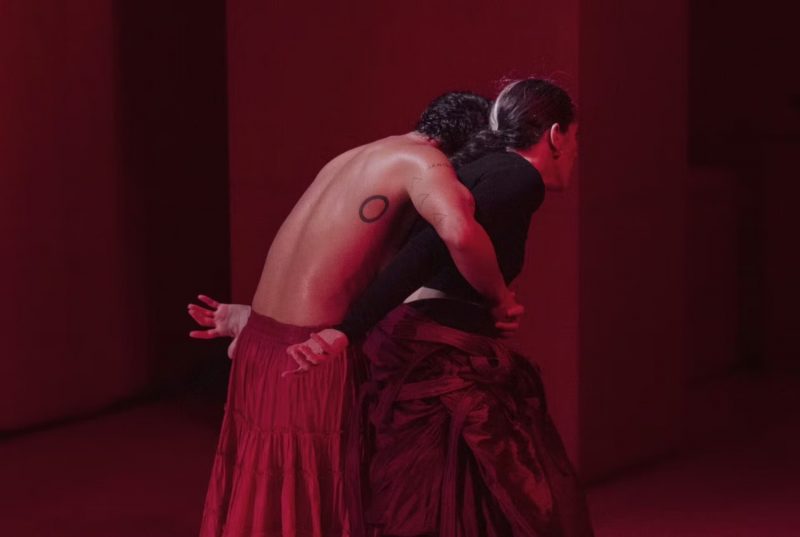
Over the past few years, Wu Tsang and Enrique Fuenteblanca have collaborated on projects that explore the figures of Bizet’s Carmen, Picasso, bullfighting, and flamenco—and the institutional dispositifs that reinscribe them. Their interest in these figures is shaped by an idea of performativity that participates in the construction of a certain imagination of the European “South,” in close relation to colonial imaginaries, tourism, and the like, yet also exceeds those frames.
In this conversation, they approach performativity in a double sense: on the one hand, as the way in which narratives and images become bound up with race, gender, and class, shaping how we perceive the world. On the other, as the way these myths come to assert themselves not only as “universals,” but as forces that intervene in real lives and cultural fields: institutions, tourist economies, art scenes, and specific communities.
How did Picasso build his own image to the point of influencing our modern idea of the artist, and on what figures of “otherness” did he rely? How does the mythic identity of Carmen affect a particular projection of the “South” of Europe—or the very idea of “femininity”? How does a supposed flamenco identity coexist with the performativity an interpreter deploys before a participatory audience? And, ultimately, how are these fundamental crossings between poetics and politics produced? What follows is their exploration of these questions through work that remains in progress.
EF: Our collaboration began with your trip to Seville to visit the places where the myth of Carmen is set. Since 2023 we’ve been researching together how the myth is constructed and how it saturates—consciously or unconsciously—an almost ungraspable imaginary. But when you arrived in Seville you had already begun this process long before. When did your research start, and in what context?
WT: I began researching in 2018, and one of our early performances was already playing with orientalist elements of the opera. Later, when I started working on a larger project on Carmen for the Schauspielhaus Zürich at the beginning of 2023, I travelled to Seville, where the story is set. That’s where I connected with BNV Producciones, the collective you work with.
EF: You’ve told me your interest began after a conversation you had with Fred Moten—how did that happen, exactly?
WT: Yes. I remember asking him—about eight years ago now—if you could work on an opera, which one would it be? I was surprised when he mentioned Carmen, because it’s so popular and so mainstream. He talked about the music, about the non-Western influences in it, about how sounds come through from the other side of the Mediterranean and the Atlantic. That planted a curiosity, because I love working with questions of fluidity, especially in musical and dance forms.
I’m curious: when we first met, what was your (and BNV´s) reaction to my project —given your work with flamenco?
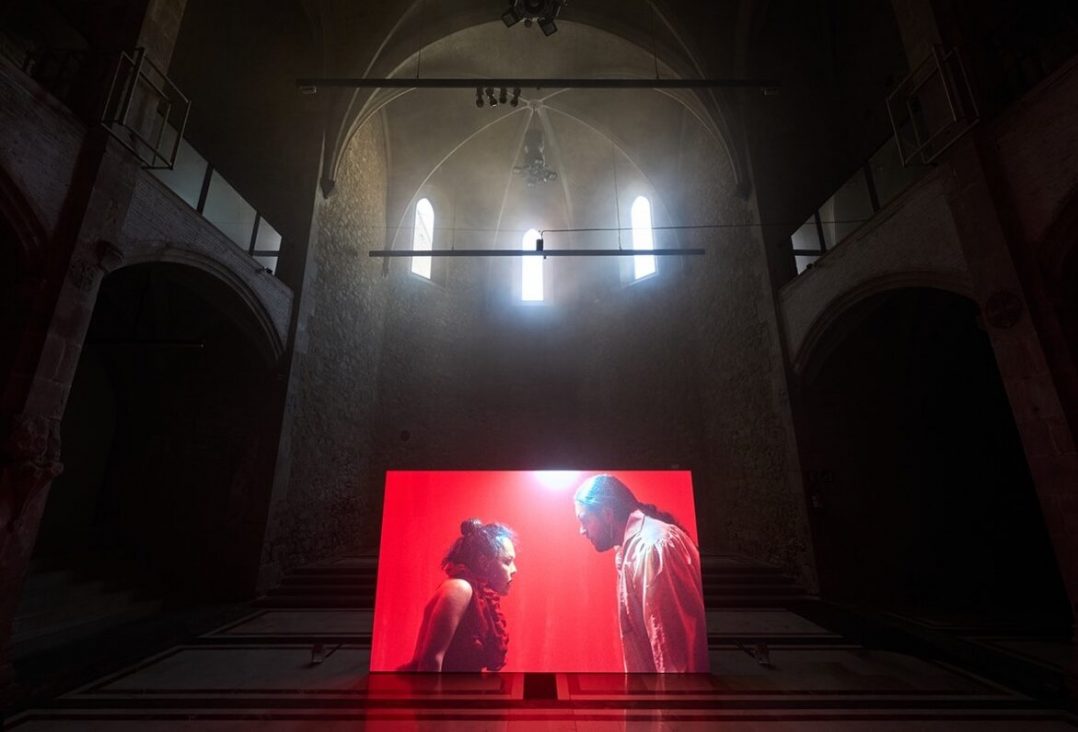
EF: Returning to Carmen means returning to a huge archive we’d already been working with for some time. And for me the important thing is this: to explore the concept of representation, not only the opera itself.
Carmen and flamenco are distinct “fields of meaning,” but their histories are intertwined. Both are built through a double tension: they’re perceived as symbols of national identity and yet neither could have been conceived without an external gaze that shaped them into myths. And those constructions, in turn, produce reality. You were especially interested in how the myth is built, and I think that’s at the base of everything we’ve done together. I remember you describing how, when you visited the “Carmen sites” in Seville, you felt the story was told as if she had truly existed. In that “becoming real,” you saw something performative, tied to identity.
WT: What struck me most was how real the myth felt in Seville—which makes sense if we think about tourism. On a “Carmen tour,” a local guide showed us places around the city where the story is supposed to unfold, and I was fascinated by his reenactment: of course those events weren’t real, but he was so invested in the narrative that, for him, it became real.
For me, that revealed another layer of meaning: the way we construct mythology is always done from the present, always through our renarrations and our desires. And in flamenco there seems to be a parallel process: playing with constructions of tradition is also charged with mythology.
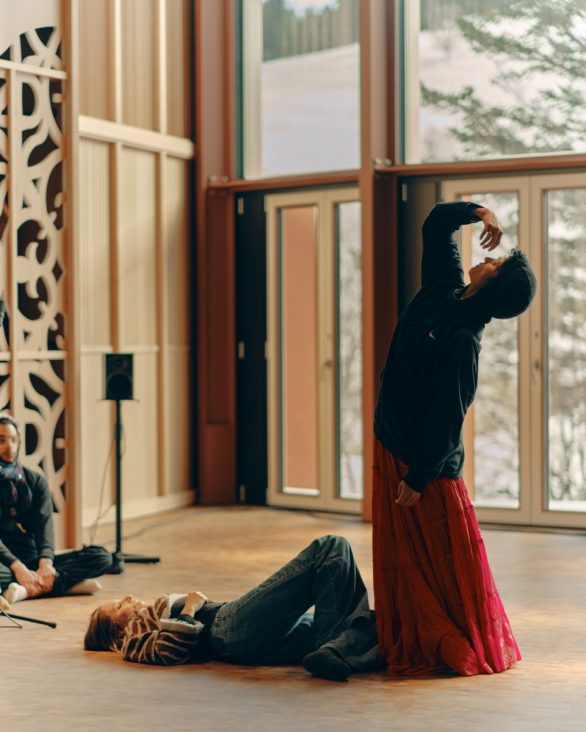
EF: Exactly. When we met we were immersed in work around pie.fmc, a platform conceived by Pedro G. Romero from which we think flamenco as a cultural field, not only as a set of songs or dances. And here “popular” is a complicated word. In Spanish, popular is not the same as folkloric: it’s tied to the construction of the nation, of “the people,” but it also carries a pejorative connotation, as if it were the culture of dispossessed people, of the foreign, of the marginal. “Flamencos” were used as a national emblem at the same time that they belonged to a marginalized community.
We presented a phase of the project at De Balie in Amsterdam titled Carmen and Freedom. There we explored how the construction of the flamenco cultural field intertwines with the myth of Carmen.
Both crystallized into their recognizable forms when Spain—though still a colonial power in the Americas—was in “decline” and beginning to be culturally colonized by Northern Europe through commerce and the exoticism of the Grand Tour. That is the Spain that inspired Mérimée and Bizet; and that is why, in both flamenco and Carmen, we can trace archives of resistance and alterity, but also a strong mythologization.
WT: I’m still new to learning flamenco, but I’m fascinated that both seem to play with clichés and with “tradition.” There can be no Carmen without clichés: the mantilla, the fan, the cigarette, the flower… The audience is drawn to the reenactment of its fantasy, to the otherness she represents.
But you can also use the very same tools that present that fantasy in order to destroy it. That is, ultimately, what Carmen means to me: she’s a condensation of clichés and fantasies, but she escapes being that thing. If it’s done well, she remains ungraspable. Flamenco, it seems to me, works in a similar way: tradition itself is like a myth, and the performer plays with the audience’s expectations by offering it, showing it, withdrawing it—destroying it.
EF: In that regard, Moten wrote a phrase that haunts us: “Carmen isn’t going to give you space. Every time she dies, she comes back in another way.” Another key aspect is her multiplicity. If you tried to gather all the images of Carmen, it would be impossible—her representation is saturated—and that becomes central in the film version you’re developing as part of a new opera.
Joaquín Vázquez—who, from BNV, also participated in the research—kept insisting on a touchstone: Carmen is made of too many identities, to the point that they even rub against each other. When we talk about the political dimension of Carmen, we approach it through different simultaneous forms of “subalternity”: she is a woman among men, a Spanish Roma among payos, a marginal figure who disrupts military order—and yet she also betrays the Roma in the mountains. Always “other.” She condenses all these aspects, and they collide at the moment of a possible emancipation.
It’s curious that, in an apparently opposite sense, this same multiplicity appeared when we began working on Theatre Picasso, the exhibition Tate Modern commissioned from us. There we tried to apply these same ideas through performativity in Pablo Picasso. In a way, thinking the saturation of Carmen helped us think another saturation: that of “genius” as a constructed and projected character, and the museum as a stage where that character is rewritten.
WT: Being invited as artists—and being conscious that our role is not that of curators or art historians—our starting point was the idea that what the public and the institution expect from us is a creative gesture, not a conventional exhibition. That’s why it felt appropriate to make a gesture that, rather than establishing new hegemonic discourses about Picasso, allows a multiplicity of voices and approaches to emerge—voices capable of responding to that complexity.
Approaching Picasso, the first thing we thought was to understand how these two concepts operate in him. We believe his use of performativity as a tool, and his constant attention to different forms of subalternity—Blackness, the sexualized, androgyny, the popular, bullfighting, circus performers, to name just a few—define to a great extent the relevance and contemporaneity of his work. And at the same time there was something that interested us a lot: that will to produce tension, even discomfort, through popular imaginaries of otherness. That raises problems—because those imaginaries are charged—but it also reflects an era and therefore becomes an untimely point of reference for thinking about how “the universal” is made.
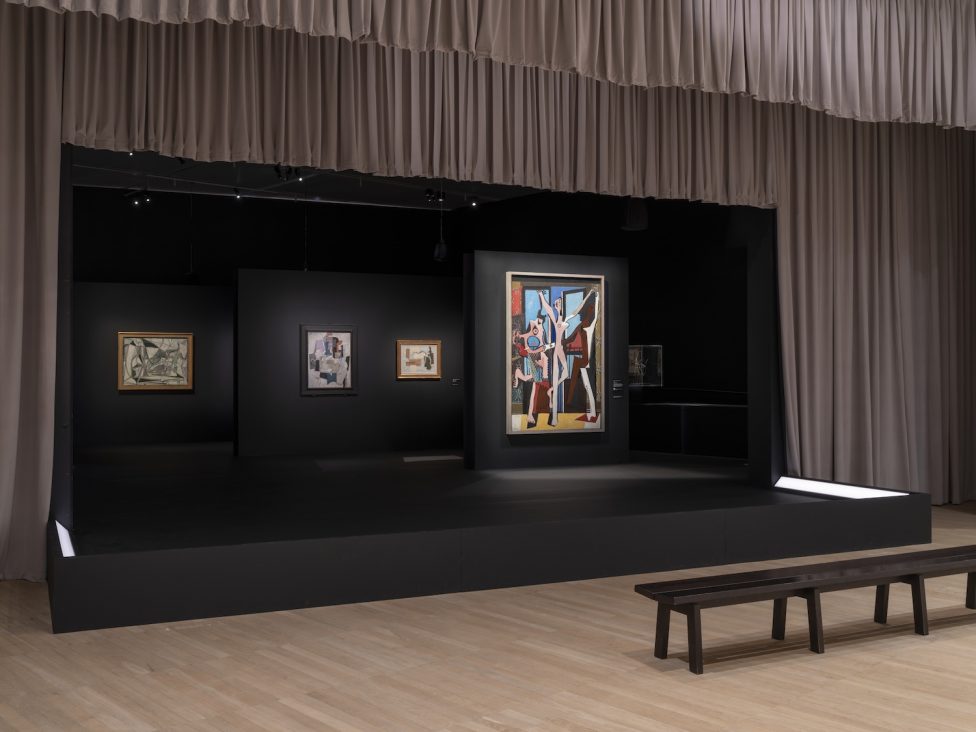
EF: In that sense—and precisely because it’s an “ontologically soft” concept—performativity has been central for us. On the one hand, performativity as theatricality: the capacity to situate gestures in time and space, to “stage” them, to cultivate a persona. On the other, performativity in the sense of “doing things with words” and with acts: that which not only represents, but produces world. And also—as Diana Taylor would say—as attention to a network of reiterated behaviors that configure archives of resistance of subaltern bodies.
WT: For the exhibition, we generated a display in which the works contained in the museum’s expanded collection are shown and interrogated from the present. That display takes the form of a theatre. The idea was to think of Picasso as a “performer,” attending to how he constructed his own image. And there was a second aim: to explore how collections that need to interrogate themselves might be shown.
The theatricality we proposed—and which, in a way, we took from Picasso himself and from his stage designs for the Ballets Russes, with particular attention to Cuadro flamenco—produces an effect of visuality over what it shows. But at the same time it makes the audience a participant and draws the public into the mechanism. The impact was precisely that: to point out that we, too, are part of the theatre that Picasso helped, without a doubt, to build. And from there, to show the complexities of Picasso as a fundamental piece for understanding the construction of contemporary arts and their different receptions over time: sublimations, rejections, appropriations.
EF: Exactly. And then there are his masks: it was important to understand what it meant for him to assume or represent the figures of the harlequin and the acrobat, the bullfighter and the musician; the one who wants to seem younger or older; the one who presents himself to the public as a genius or a fool, a dreamer or a destroyer. That’s why we wanted to give a special place to The Mystery of Picasso. And also to insist on those constructions—so present in his painting—that seep into the popular and reconfigure it.
The idea was that Clouzot’s soundtrack would contaminate the way of seeing, attending to what Fred puts so precisely when he says that, sometimes, “sound gives back what ocularcentrism has repressed.” If the museum is a theatre of the gaze, sound displaces that theatre: it reorganizes what can appear and what remains outside.
This is where flamenco and jazz figures reappear throughout Picasso’s work. The relationship is deeper than a merely thematic question. And there was also avant-garde music, generating a field of tensions that allowed us to understand better how Picasso always situates himself between “high” and “low” culture. In fact, Clouzot’s own music already rests on that avant-garde gaze toward the popular.
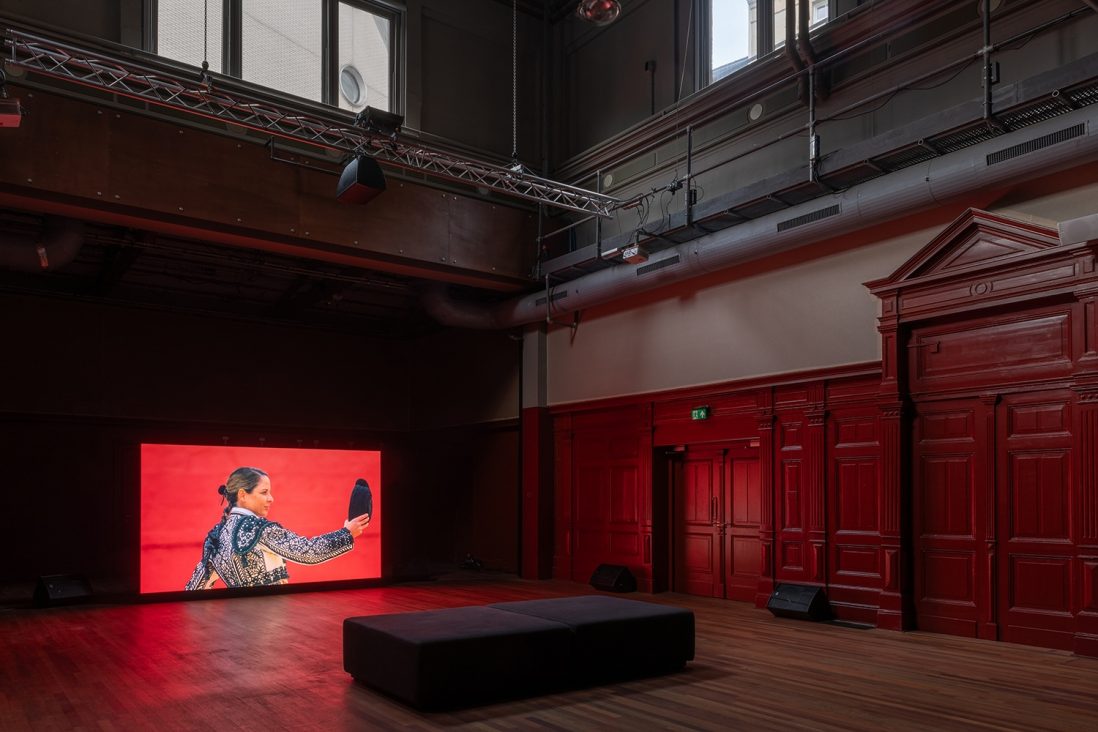
WT: Yes, and for that it was important that Nathaniel Mackey’s text Cante moro be included in the exhibition catalogue. In Cante moro, Mackey approaches the porous, heterogeneous roots of flamenco. In one passage, he returns to the expression “cante moro” through a recording of Manitas de Plata where you hear: “That’s cante moro.” That phrase—spoken by José Reyes—opens for him a way of listening to flamenco as a hybrid archive, traversed by historical and diasporic presences. In this way he unfolds an archive of shared longing among Spanish Roma and Arab, Jewish, and Black diasporic communities, starting from the legacy of the poet Federico García Lorca.
EF: Yes. Mackey offers a singular reading of Lorca’s concept of duende, finding certain parallels with a form of performativity present in jazz and blues. He interprets duende as a troubling agent that breaks in and problematizes, and that is connected to Black sounds and musics. It’s interesting how, for him, duende also appears as something that resists capture, marked by its “mercuriality,” connected to nomadism and the spirit of fugitivity.
This interests me especially, since I can see that the relation between the filmic medium as an apparatus of capture and the image that resists—always in the process of fleeing—is one of the strongest constants in your work. That is where a particularly operative entanglement between poetics and politics takes place, one that allows us to pose an important question: how do we film a spirit of resistance without capturing it? How do we preserve what “touches us” in lived experience on video? I think all your films take special care in trying not to “harm” those images—and those who generate them.
WT: For a long time I’ve been obsessed with the idea of the image that can’t be captured. I think that’s what pushes me to make cinema: that impossibility in tension with the desire to see ourselves and be seen by others. That’s what drew me to flamenco from the beginning, and to performative arts in general.
In a flamenco performance there’s always something that escapes the camera—especially in the sound and in the way compás can stretch our experience of time. As our collaborator Yinka Esi Graves says, you can’t understand flamenco unless, as an audience, you’re able to “get inside”: it’s not enough to witness it or consume it. You can’t understand it from the outside; you have to be inside. And I love how that problematizes the presence of the camera: can a camera “get inside”? It’s an exhilarating challenge to film while keeping those questions in mind.
EF: Since we’re continuing to work on new projects around Carmen, we could return to where the conversation began. We’ve tried to “grasp” her in so many ways—opera, installation, film, compositions—and yet she resists. I’d say you’re playful with those mechanisms of capture: you let the work drift beyond fixed disciplines, you look for Carmen in blurry spaces. And yet we keep trying to seize her, even as we feel she chooses to die before being captured and losing her freedom. Is it possible to establish a parallel between Carmen’s “ungraspability” and her constant death, and the history of her representation—and thus repetition? In your works, in one way or another, the loop is always present.
WT: For me, the opera, the film, and the installation were the first attempts to understand. But they were also excuses to sustain an investigation as a form of relationship: to keep working together, to keep talking with you and with BNV, with the collective Moved by the Motion, with Fred, and with more and more collaborators entering the constellation.
And maybe that’s what interests me most about the myths we work with: it’s true that Carmen—as with Picasso—never fully resolves; it doesn’t close. Every time she seems to be fixed, she comes back from another angle. And she forces us to return too—not to repeat the myth, but to listen to what the myth is doing—to whom it is touching, whom it is erasing, whom it is igniting—in the present.
Bibliographical notes:
[1] The following projects are mentioned throughout the conversation: Carmen (opera, Schauspielhaus Zürich); La gran mentira de la muerte (audiovisual installation, MACBA); Carmen and Carmen (multidisciplinar project, de Balie); Carmen in the Mountains (sound piece, Kunsthaus Zürich); Theatre Picasso (exhibition, Tate Modern); and a new opera under development (title to be determined).