

FOREWORD
In just a few years, artificial intelligence has moved from being a specialised subfield of computer science to decisively transforming contemporary visual culture. This shift cannot be explained solely by computational advances, but by the turn toward models capable of “seeing.” The transition from the symbolic paradigm —which understood intelligence as the manipulation of symbols— to connectionist approaches oriented toward pattern recognition enabled the mechanisation of visual perception. Once machines cease to operate exclusively on explicit representations and begin to interpret, classify, and generate images, those images become operational vectors that reconfigure the relationship between model and world.
This change accelerated the development of AI and turned computer vision into one of its pillars. From autonomous driving to urban surveillance and digital platforms, images have become the raw material for systems that learn without explicit instructions. Long before the generative turn, it was advances in computer vision that guided the direction of research and expanded its ambitions.
Meanwhile, AI has become embedded within social infrastructure. Algorithmic management organises labour in logistics and service platforms; the same logic underpins policing and border-control systems that inscribe historical biases into devices presented as objective. In military contexts, task delegation intensifies forms of remote violence, while algorithmic modulation of behaviour deepens social atomisation. Taken together, these processes reveal how algorithmic mediation permeates contemporary existence, and the central role images play within it. Under this premise, the issue approaches this plurality with systematic intent.
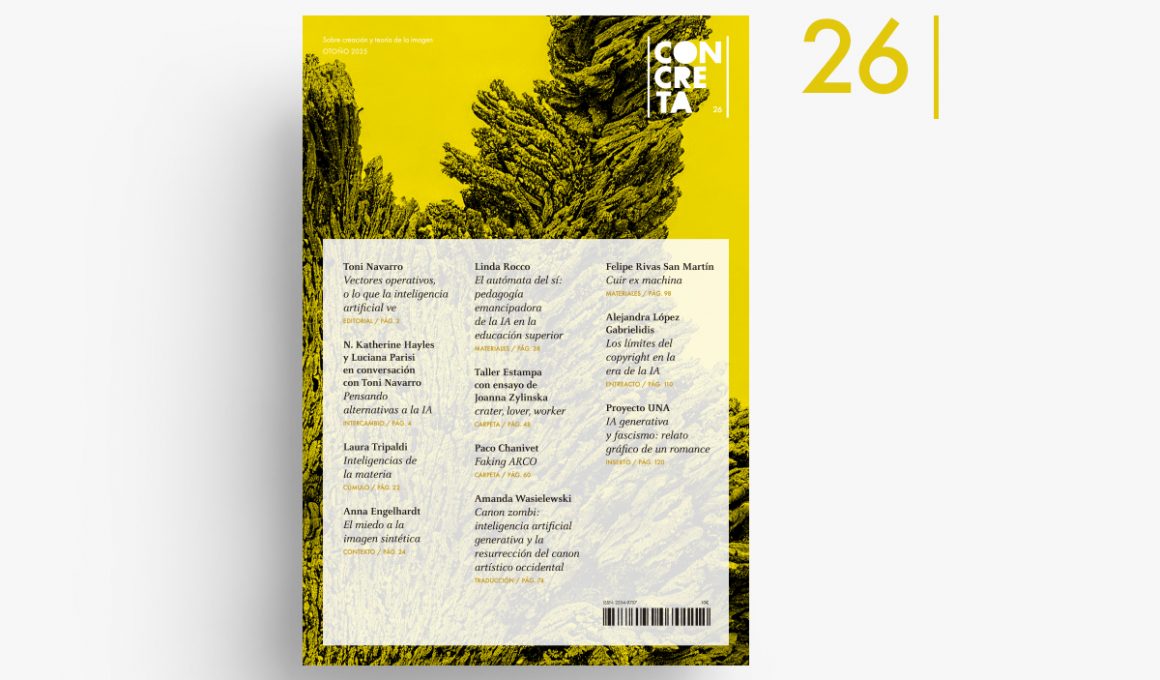
The volume opens with an exchange between N. Katherine Hayles and Luciana Parisi. Drawing on their reflections on algorithmic intelligence, their conversation traverses computation and the tensions between the biological and the technical in order to imagine alternatives to AI beyond racial capitalism. This is followed by Laura Tripaldi’s proposal, which offers a poetic approach to the intelligences of matter through organisms, materials, and mythologies that evoke “soft futures.”
From a political standpoint, video artist and writer Anna Engelhardt examines synthetic imagery through her research on algorithmic infrastructures. For her, such images are not mere threats to documentary truth but operational elements in military and logistical contexts. In a different register, Linda Rocco analyses the impact of generative AI on higher education, warning about the risk of cognitive dependencies and advocating for co-inquiry pedagogies capable of confronting algorithmic opacity.
The poetic dimension takes on a humorous tone in crater lover worker, a project by Taller Estampa that explores how computer-vision tools construct worlds. A text by Joanna Zylinska accompanies the project, contrasting the critical tradition of visual studies with the reductive logic of computational vision. From another angle, Paco Chanivet presents an “artificial generative-art fair” created with models trained on images of real exhibitions, questioning the boundaries between originality and reproduction.
Also from the artistic field, Amanda Wasielewski shows in Zombie Canon how art datasets perpetuate Eurocentric biases. This genealogy is complemented by Felipe Rivas San Martín’s contribution, whose work has explored the intersections between algorithms and dissident identities for more than a decade.
To speak of generative AI necessarily involves addressing concerns about its impact on labour and accusations of plagiarism. Alejandra López Gabrielidis analyses these tensions through the limitations of copyright and argues for collective compensation mechanisms that recognise the cultural value embedded in digital datasets.
The issue closes with a web project by Proyecto UNA examining the alliance between techno-oligarchies and far-right movements, and the possibility that generative AI may constitute a new fascist aesthetic. They reconstruct a genealogy of AI as a pattern-making machine, analyse the concentration of power in a technological oligopoly, and trace aesthetic connections between AI and certain proto-fascist avant-gardes.
Taken together, the issue shows that AI is neither merely a technical instrument nor simply a source of aesthetic novelty, but an assemblage in which perception, cognition, politics, and materiality intersect. Understanding these systems requires approaching them as technologies, cultural devices, and social infrastructures—and imagining strategies that rethink the very foundations of the intelligence they produce.